
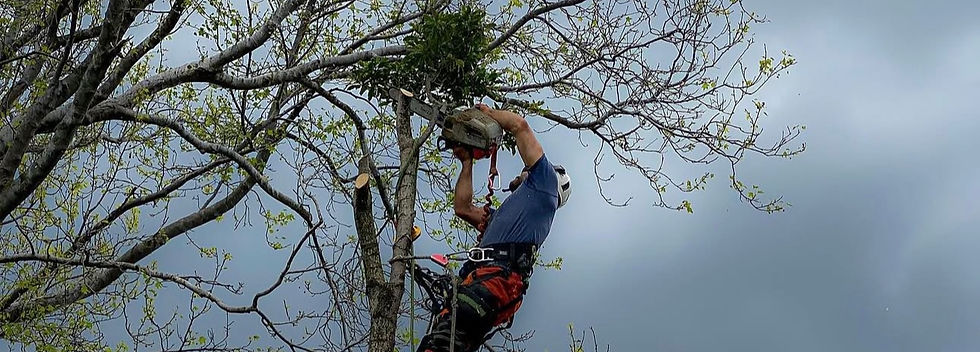
Tree Pruning
The Full Story
Pruning keeps a tree healthy, safe and the right size for its space. Done properly, it removes problem growth without spoiling the tree's natural shape. Our Level 5 qualified arborist plans every pruning job before a cut is made, and we talk you through exactly what will come off and why. The main types of pruning we do are crown reduction, crown lifting, crown thinning and dead wooding.
Crown reduction
Crown reduction lowers the height and spread of a tree while keeping its natural shape. It suits trees that have outgrown a tight space, such as between two houses or over a roofline. Benefits include:
• Keeps the tree's natural shape
• More light into the yard and the house
• Less risk of branches damaging buildings, roofs and gutters
Crown lifting (crown raising)
Crown lifting removes the lowest branches to raise the base of the canopy. It is the usual fix for branches hanging over driveways, paths, fences and roads. Benefits include:
• More usable space underneath, which makes a garden feel bigger
• Clear sight lines along roads and driveways
• Clear access for people and cars on paths, nature strips and car parks
• Less risk of low branches damaging buildings and property
Crown thinning
Crown thinning selectively removes smaller branches from inside the canopy while keeping the overall shape of the tree. Benefits include:
• More light through the canopy
• Less wind load. A dense crown catches the wind in storms, and thinning lets air move through it, lowering the risk of branch or tree failure
• A lighter, more balanced look
Dead wooding
Dead and dying branches can fall without warning and damage property or hurt someone underneath. Dead wooding removes them before they drop, and it is often done alongside other pruning. For most mature trees we recommend dead wooding every 2 to 3 years.
Why we don’t top trees
Topping means cutting a tree back hard to reduce its height. It may look tidy at first, but as a rule no more than 30 percent of a tree's crown should be removed at once. Topping causes four main problems:
1. Large cuts let in fungal disease and rot, which make big limbs dangerous.
2. A tree's leaves make its food. Removing most of them starves the tree and makes it prone to disease, including root rot, a common cause of tree failure.
3. The regrowth is weakly attached and breaks easily in wind. A regrown limb never has the strength of the original.
4. Dense regrowth makes the tree top-heavy, so it catches more wind and is more likely to come down in a storm.
If a tree is too big for its space, crown reduction or removal is the safer option.
Where we prune: Berwick, Narre Warren North, Narre Warren and the rest of Melbourne's South East. Call 0481 111 804 for a free pruning quote.


Let’s Work Together
Get in touch so we can start working together.